


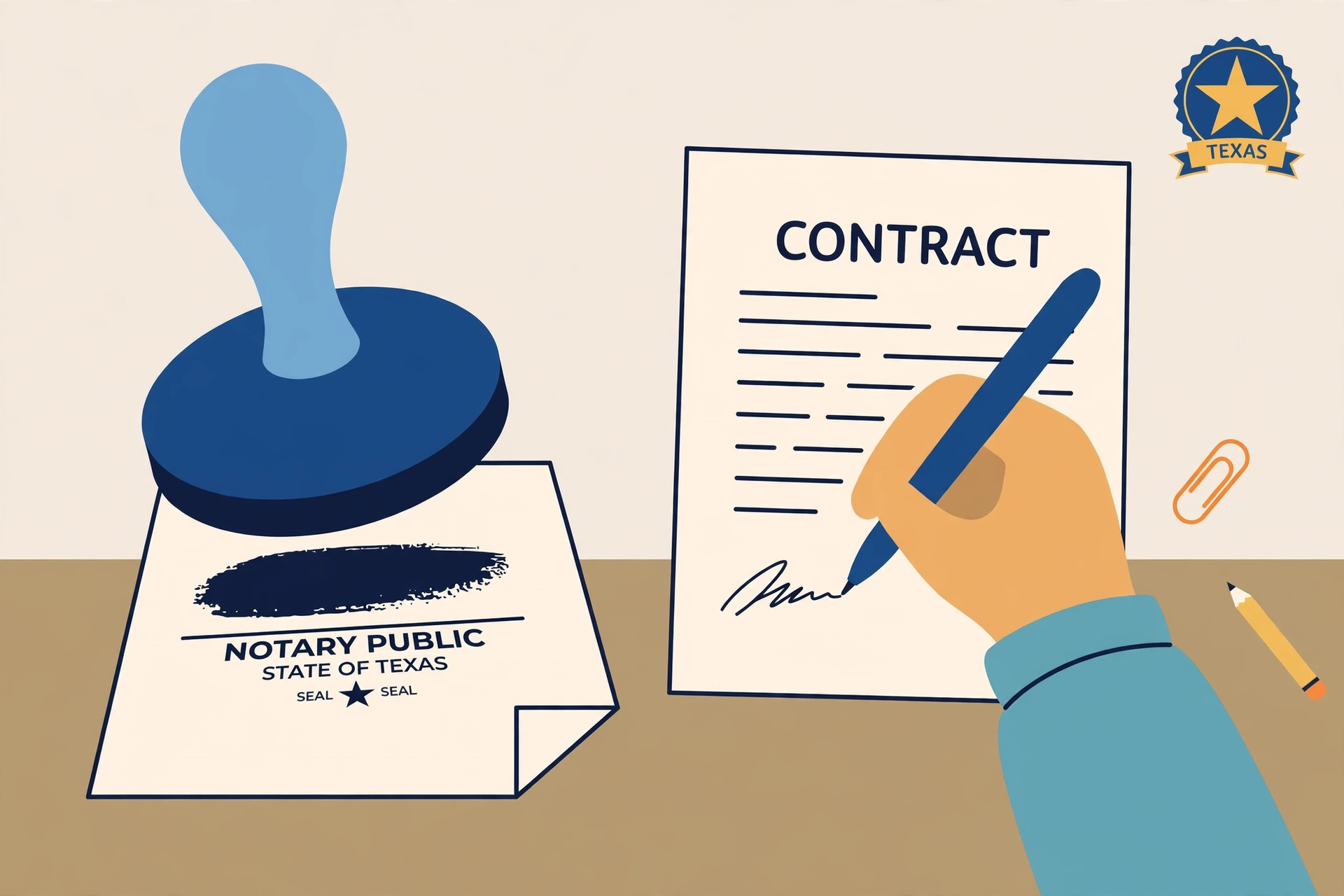
Nobody grows up dreaming of visiting a notary. Then one day a form says "must be notarized" and you are googling what that even means at 9pm. If you live in Texas and have never done this before, here is the whole thing in plain English: what a Texas notary actually does, what it costs under Texas law, what to bring, and whether you even need an appointment.
What a Notary Does, in Plain English
A notary public is a person appointed by the state to serve as an impartial witness for important signatures. The job boils down to three things:
1. Verify identity. The notary checks that you are who you claim to be, usually with a government-issued photo ID.
2. Witness the signing. The notary watches you sign to confirm you did it willingly and without pressure.
3. Deter fraud. The notary records the act in an official journal and stamps the document with a state-issued seal, creating a paper trail that makes forgery much harder.
That is the whole job. A notary does not approve your document, does not give legal advice, and does not check whether the contents are correct. They certify the signing process, not the substance. Think of it this way: the notary answers one question, "did the right person sign this willingly?" Nothing more.
What a Texas Notary Is Legally Allowed to Do
Texas authorizes notaries to perform a specific set of acts. In everyday language:
- Acknowledgments: confirming that the person signing a document (a deed, a contract, a power of attorney) is who they claim to be
- Oaths and affirmations: administering sworn statements for affidavits and similar documents
- Jurats: certifying that a document was signed in the notary's presence after an oath was given
- Certifying copies: verifying that a copy is a true reproduction of an original, for certain document types
Notaries are public officers of the State of Texas. That sounds formal, but for you as a customer it just means the person across the counter is state-authorized to do this, which is exactly why banks and title companies trust the stamp.
What a Notary Does NOT Do
Worth saying clearly, because it trips people up: a notary cannot explain your document, tell you whether you should sign it, or give legal advice of any kind. If you do not understand what you are signing, sort that out with the party that gave you the form, or with an attorney, before your appointment. A notary who starts advising you on the contents is overstepping.
Documents Texans Commonly Get Notarized
You might need a notary more often than you think:
- Real estate paperwork: deeds, refinancing documents, closing forms
- Powers of attorney: giving someone authority to act on your behalf
- Affidavits: written statements sworn to be true
- Vehicle title transfers: common when selling a car in Texas
- Parental consent forms: for a child traveling with one parent or a group
- Business contracts where both parties want extra assurance
One Texas-specific nuance worth knowing: wills themselves do not require notarization in Texas. But most Texas wills include a separate self-proving affidavit, and that affidavit does get notarized. It is a sworn statement by the witnesses that makes probate smoother later. So if an attorney hands you will paperwork and mentions a notary, this is almost certainly what they mean.
What It Costs in Texas
Here is the good news: Texas law caps notary fees, so you will never be blindsided. Under the current Texas Government Code fee schedule, a notary may charge up to $10 for an acknowledgment or jurat involving the first signature, up to $1 for each additional signature on the same document, and up to $10 for administering an oath or affirmation. These are ceilings, not fixed prices, so many neighborhood notary offices charge less.
A straightforward single document at a walk-in shop usually costs less than your lunch. Fee caps can change over time, so treat the numbers above as the schedule in effect as of 2026. If someone quotes you a large fee for a basic notarization, get a second opinion.
Walk-In vs Mobile Notary in Texas
You have two ways to get it done, and the right one depends on your situation:
Walk-in is the everyday option. You bring your document to a local shop during business hours, and you are usually in and out in under ten minutes. Cheapest option, no appointment needed at most places.
Mobile notary comes to you: your home, office, hospital, or anywhere the signer cannot easily travel. Expect a travel fee on top of the notarial fee, which is fair since they are driving to you. In the Houston area, a typical mobile appointment runs noticeably more than a walk-in visit, so use mobile when someone cannot get to a shop, not just for convenience.
Simple rule: if everyone can travel, walk in and save the money. If a signer is homebound, in a facility, or juggling a closing deadline, mobile is worth every penny.
What About Online Notarization in Texas?
Texas allows remote online notarization, where you appear before the notary over an audio-video call instead of in person. It is a legitimate option and useful when signers are in different places. That said, it involves identity verification steps, scheduling with an approved online notary, and technology that has to cooperate. For a single straightforward document, walking into a local shop is still faster and simpler for most people. Ask your notary if you are curious whether your document qualifies for the online route.
What to Bring So It Takes Five Minutes
Show up prepared and the whole thing is over in minutes:
A current photo ID. Driver's license, state ID, or passport. The key word is current. An expired ID is the number one reason people get turned away.
The document, unsigned. Do not sign before you arrive. The notary must watch you sign. Already signed it? You may need a fresh copy.
Every person who needs to sign. Both people, both IDs, both physically present. A notary cannot notarize for someone who is not there.
Payment. Fees are small, but bring a card or a few dollars cash as backup.
First-Timer Mistakes to Avoid
- Signing beforehand. The most common mistake, every time. Wait for the notary's cue.
- Bringing an expired ID. Check the date before you leave home.
- Forgetting a required signer. If your spouse signs too, they come too, with ID.
- Bringing an incomplete document. Fill in everything except the signature first. A notary cannot notarize blanks.
- Expecting legal advice. The notary witnesses. A lawyer advises. Different jobs.
Frequently Asked Questions
How much does a notary cost in Texas?
Texas caps the fees: up to $10 for an acknowledgment or jurat with the first signature, up to $1 for each additional signature on the same document, and up to $10 for administering an oath. Most walk-in visits for a single document cost well under $15 total. Mobile notaries add a travel fee.
What do I need to bring to a notary in Texas?
A current government-issued photo ID, your unsigned and completed document, every person who needs to sign (with their own ID), and a way to pay. That is the whole list.
Can a Texas notary give me legal advice?
No. A notary is not a lawyer and cannot explain your document or advise you whether to sign it. If you have legal questions, consult an attorney before your appointment.
Do I need an appointment, or can I walk in?
Most neighborhood notary offices in Texas accept walk-ins during business hours, and a simple notarization takes just a few minutes. Call ahead if you have multiple documents or an unusual situation.
Does a will need to be notarized in Texas?
The will itself does not require notarization to be valid in Texas. However, most wills include a self-proving affidavit, which does get notarized and makes the probate process smoother later.
How long does notarization take?
For a single straightforward document, usually five to ten minutes once you are with the notary. Bringing your ID and an unsigned, completed document is what keeps it quick.
Walk In and Be Done in Minutes
If a form says "must be notarized," skip the stress and the runaround. Print N Ship 4u in Katy, TX offers notary public services with walk-ins welcome during business hours. Bring your unsigned document and a valid photo ID, and we will have you signed, sealed, and on your way in minutes. Need the document printed first? We do that too, along with passport photos and shipping, all in one stop. Call (281) 375-9714 or just stop by the shop.