


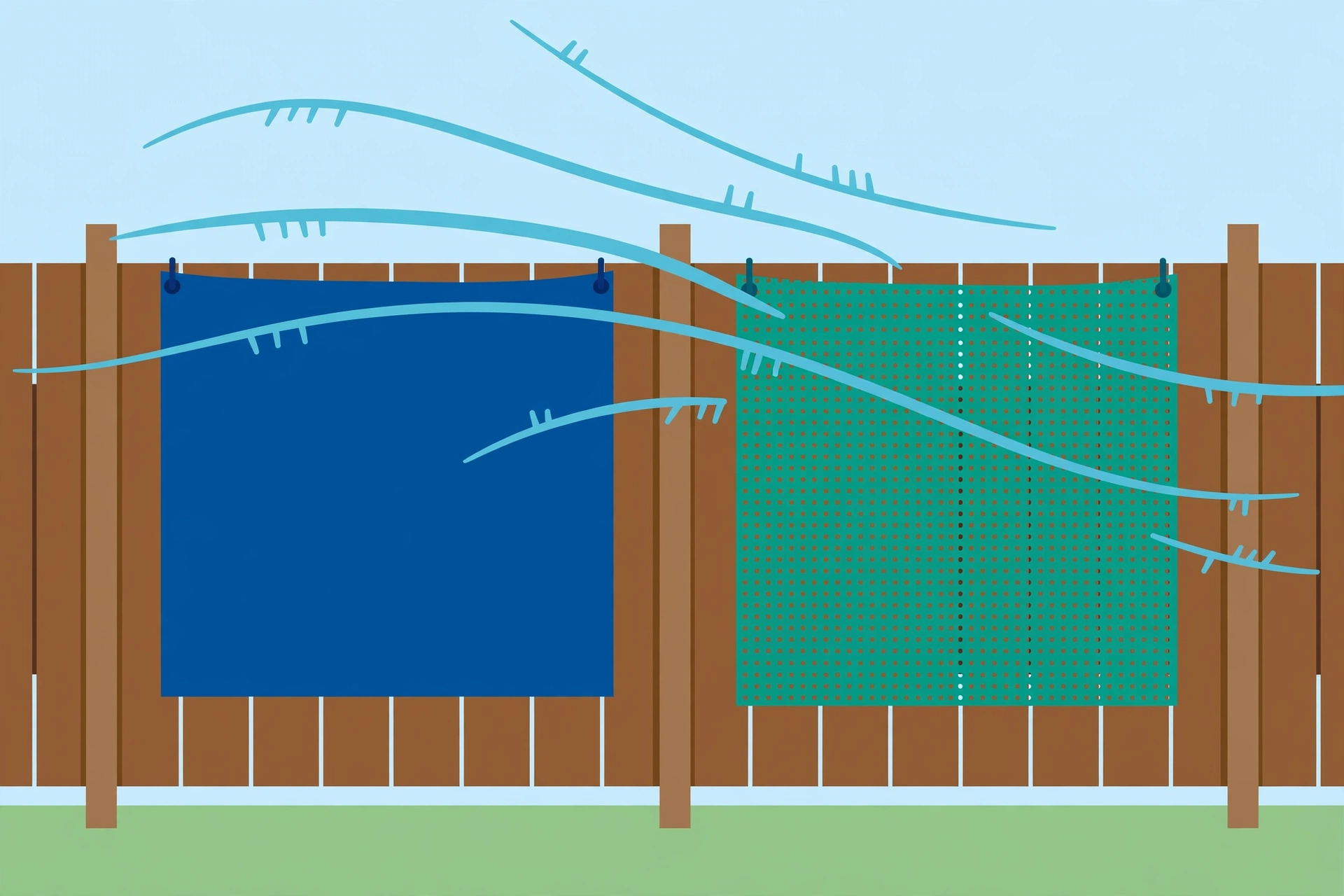
An outdoor banner sounds like a simple purchase until you are choosing between vinyl and mesh at the counter. They look nearly identical in the proof. The prices sit in the same ballpark. But hang the wrong one in the wrong spot, and you will learn a memorable lesson about wind, usually while picking your banner up off the parking lot.
This guide compares vinyl vs mesh banners on what actually matters: wind, print quality, lifespan, and the real cost over time. By the end you will know exactly which one your location needs.
The 30-Second Answer
Choose vinyl when the banner hangs somewhere sheltered: on a building wall, under an awning, indoors, or at a trade show. It looks sharper, costs a little less, and lasts longer when wind is not a factor.
Choose mesh when the banner faces the open air: on a fence, between poles, at a construction site, or anywhere gusts hit it regularly. Wind passes through mesh instead of tearing it down.
| Vinyl banner | Mesh banner | |
|---|---|---|
| Material | Solid PVC sheet, usually 13 oz | Perforated vinyl, usually 8 to 9 oz |
| Wind handling | Catches wind like a sail | Air flows through the holes |
| Print quality | Sharpest, richest color | Slightly softer, still great at distance |
| Waterproof | Fully waterproof surface | Water resistant, lets rain pass through |
| Best spots | Walls, indoors, sheltered areas | Fences, poles, exposed sites |
| Upfront cost | Usually a bit less | Usually a bit more |
What Is a Vinyl Banner?
A vinyl banner is printed on a solid sheet of flexible PVC, most commonly around 13 ounces for outdoor use. It is the classic banner everyone pictures: smooth, fully opaque, with rich saturated color and crisp detail. Edges get hemmed and fitted with metal grommets so you can hang it with rope, bungees, or zip ties.
Vinyl is waterproof, wipes clean with a hose, and looks fantastic up close because the print surface is perfectly smooth. Its one real weakness is physics: a solid sheet catches wind like a sail. In a calm or sheltered spot, that never matters. On an exposed fence on a windy corner, it matters enormously.
What Is a Mesh Banner?
A mesh banner is printed on perforated vinyl covered in thousands of tiny holes. From ten feet away it looks like a normal banner. Up close you can see the perforation, and that is the entire point: wind passes straight through instead of hammering the material.
You will see mesh described with ratios like 80/20 or 70/30. That is the split between printable surface and open hole area. More open area means more wind passes through but slightly less ink coverage. For most fence and outdoor advertising jobs, the standard 80/20 style hits the sweet spot between airflow and print quality.
Because air flows through, mesh puts far less stress on grommets, ropes, and whatever it is tied to. The tradeoff is print sharpness. Those tiny holes mean slightly muted color and softer fine detail compared to solid vinyl. From normal viewing distance, across the street or across the field, most people never notice.
Vinyl vs Mesh: The 6 Factors That Matter
Wind resistance
This is the whole ballgame. Vinyl blocks air completely, so every gust pushes the full force into the banner and its mounting points. Mesh lets a large share of that air through, which dramatically cuts the load on grommets and ropes. On a fence line or between two poles, this single factor decides everything.
Print quality and color
Vinyl wins cleanly. The solid surface takes rich, saturated color with sharp edges, which is why photographers, detailed logos, and small text all look best on vinyl. Mesh is a step softer. Fine detail holds up, but side by side with vinyl you can see the difference up close.
Lifespan outdoors
Here is the nuance most guides skip: lifespan depends on the enemy. In a sheltered spot, vinyl typically outlasts mesh because the solid material resists UV and rain beautifully, often looking good for a couple of years. In a windy spot, mesh wins by a mile, because vinyl fails structurally, torn grommets, ripped hems, long before its print ever fades. Banners rarely die of old age. They die of wind.
Cost over time, not just the quote
Mesh usually costs a bit more upfront since the material is pricier. But do the real math. A vinyl banner that tears off a fence in three months and needs reprinting costs you twice. A mesh banner that survives two full seasons costs you once. In windy locations, mesh is the cheaper banner even with the higher quote. In sheltered spots, save your money and go vinyl.
Water behavior
Vinyl is a complete water barrier, which is great in rain. Mesh lets rain pass through, which sounds like a downside but actually helps: water does not pool against it, and it dries faster after a storm.
Visibility up close vs far away
Banners are meant to be read from a distance, and both materials do that job. The difference only shows within a few feet. At a trade show booth where people stand close and study details, vinyl's crispness wins. On a fence read from passing cars, mesh looks just as bold.
5 Installation Mistakes That Kill Banners Early
We see dead banners come back to the shop, and it is almost never the material's fault. It is one of these:
1. Hanging it drum-tight. A banner stretched rigid has nowhere to flex when a gust hits, so all the force goes into the grommets. Hang it taut but with a little give.
2. Using only the corner grommets. Every grommet exists for a reason. Skipping the middle ones concentrates the load on four points instead of spreading it across ten or twelve.
3. Thin rope or cheap zip ties. Undersized fasteners snap or saw through hems. Match the hardware to the banner size, especially for anything over a few feet wide.
4. Ignoring the forecast. If a serious storm is coming and you can take the banner down, take it down. No banner material is designed to fight hurricane-force wind, and we say this as people in the Houston area who know.
5. Folding instead of rolling for storage. Folds crease and can crack the print over time. Roll the banner around a tube when it is between uses.
What About Wind Slits in Vinyl?
You may hear about wind slits: half-moon cuts sliced into a vinyl banner to let air through. They are a real middle option, and they do reduce wind load compared to solid vinyl. But they come with tradeoffs. The slits are visible in the design, they can catch and tear outward in strong gusts, and they do not come close to mesh for true wind relief. Think of wind slits as a compromise for mild-wind spots where you want vinyl's print quality. For genuinely exposed locations, mesh is still the right call.
A Note on Gulf Coast Weather
Around Katy and the greater Houston area, wind is not a sometimes problem. Spring storm lines, summer pop-up gusts, and hurricane season all punish outdoor signage. We tell local customers a simple rule: if your banner will live on a fence, a pole frame, or any open structure through storm season, go mesh and do not look back. If it hangs on your storefront wall under an overhang, vinyl will serve you beautifully for years. When in doubt, tell your print shop exactly where the banner is going before you order. A good shop asks about the location first, because we have seen what the wrong choice looks like after one good storm.
Which Should You Pick?
Pick vinyl when: the banner goes on a building wall or under cover, it is for indoor use or events, you want the sharpest print and richest color, the spot is sheltered from wind, or budget is the priority.
Pick mesh when: the banner goes on a fence, especially chain-link, the location gets regular wind, it is a large banner (bigger means more wind force), it will hang long term through changing weather, or it is going on scaffolding or a construction site.
Still unsure? Describe your install spot to your print shop. Location decides material, every time.
Frequently Asked Questions
Which lasts longer outdoors, vinyl or mesh?
It depends on wind. In sheltered spots, vinyl usually lasts longer because the solid material resists sun and rain so well. In windy or exposed spots, mesh outlasts vinyl because wind destroys vinyl structurally long before the print wears out.
Are mesh banners waterproof?
Mesh is water resistant rather than fully waterproof. Rain passes through the perforations instead of pooling, which actually helps the banner dry faster and survive storms better.
Can you see through a mesh banner?
Slightly, up close and from behind. The perforations let some light through. From normal viewing distance it reads as a solid printed banner.
Can mesh banners be double-sided?
Double-sided mesh is uncommon because light passing through the holes washes out the back side. Most mesh banners are single-sided. If you need two-sided visibility, vinyl is the better pick.
Is mesh or vinyl better for a fence?
Mesh, in most cases. Fences sit fully exposed, wind hits them constantly, and a solid vinyl banner takes the entire force. Mesh lets the wind through and stays put far longer.
Tell Us Where It Is Going
That is genuinely the most useful thing you can do. Tell us the install spot and we will recommend the right material, size, and finishing, then print it so it looks sharp from day one. Print N Ship 4u in Katy, TX prints vinyl and mesh banners in custom sizes, hemmed and grommeted in-house. Call (281) 375-9714 or stop by the shop and we will make sure your banner survives its location.